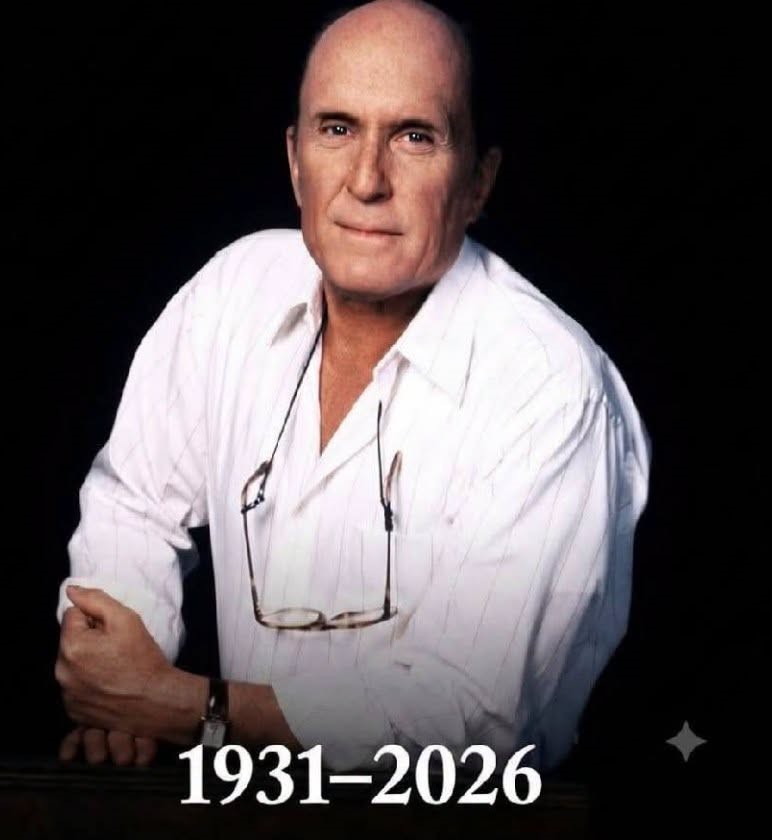
The entertainment world is remembering acclaimed American actor Robert Duvall, whose remarkable career left a lasting impact on generations of filmmakers and movie audiences. According to a statement released by his family, Duvall passed away peacefully at his home in Middleburg, Virginia, at the age of 95, surrounded by his wife and loved ones. His passing marks the end of a career that helped define some of the most memorable moments in modern cinema.
Born on January 5, 1931, in San Diego, California, Duvall developed a passion for acting at an early age. After serving in the United States Army, he studied acting alongside several future Hollywood stars and gradually established himself as a talented performer. His dedication to the craft, combined with his ability to portray a wide range of characters, earned him respect throughout the entertainment industry.
Duvall rose to international recognition through a series of unforgettable film performances. His portrayal of Tom Hagen in The Godfather and The Godfather Part II introduced audiences to his calm yet commanding style, while his unforgettable role as Lieutenant Colonel Bill Kilgore in Apocalypse Now became one of the most recognizable performances in film history. Throughout his career, he consistently delivered thoughtful and authentic performances that resonated with viewers.
In 1984, Duvall received the Academy Award for Best Actor for his leading role in Tender Mercies. The performance showcased his ability to bring emotional depth and realism to complex characters. Over the years, he earned seven Academy Award nominations, reflecting the consistent quality of his work across multiple decades. His achievements also included Golden Globe Awards, Emmy recognition, and numerous honors from film organizations around the world.
Beyond the awards, Duvall was respected for his professionalism, humility, and commitment to storytelling. Whether appearing in major Hollywood productions or smaller independent films, he approached every role with the same level of care and dedication. Colleagues frequently spoke about his strong work ethic and willingness to support fellow actors on set. His performances often demonstrated that subtlety and authenticity could be just as powerful as dramatic spectacle.
Throughout more than sixty years in the entertainment industry, Duvall appeared in a wide variety of films and television productions, including Lonesome Dove, The Apostle, Open Range, and many other acclaimed projects. His ability to adapt to different genres allowed him to remain relevant across generations of audiences, while his influence could be seen in the work of countless actors who followed.
Following news of his passing, tributes were shared by fellow performers, directors, film historians, and fans around the world. Many reflected on his extraordinary body of work and the lasting contribution he made to American cinema. His performances continue to be celebrated not only for their technical excellence but also for the humanity and sincerity he brought to every character.
Although Robert Duvall is no longer with us, his legacy lives on through the films and stories that continue to inspire audiences. His work remains an important part of cinematic history, ensuring that future generations will have the opportunity to discover and appreciate one of Hollywood’s most accomplished actors.
Tom was walking alone to school in Grozny, Chechnya, when he spotted two stray dogs basking in the sun on the sidewalk. He stopped, crouched down, and hugged them as if they were his own pets.
He eventually continued walking, but something made him stop. After standing there for a few seconds, he turned around and ran back to the dogs, hugging them again—this time even more tightly and for longer. He thought nobody was watching, but a neighbor had quietly recorded the entire moment from a window.
When the video went viral, a family friend named Katerina confirmed that the boy was Tom and revealed that his kindness toward the animals was no coincidence. She explained that he also walks her daughter to school every day and carries her backpack without ever being asked.
A simple moment, completely free of attention or praise, revealed something beautiful about Tom’s character. Whether it’s a stray dog or a little girl who needs help carrying her bag, he seems to have a natural instinct to care for others. Pure kindness when no one is watching. 🐶💛
Derek Martin built an extraordinary career from a beginning that was far removed from the world of television. Before becoming widely recognized by British audiences, Martin experienced a remarkably varied working life that included jobs as a meat porter, professional gambler, and stuntman. Those unusual experiences became part of the story behind an actor who would eventually spend decades entertaining audiences on one of Britain’s best-known television programs.
Martin became especially familiar to millions of viewers through his role as Charlie Slater in EastEnders. The character was introduced as a strong-willed family man with a complicated personality, and Martin brought a distinctive combination of toughness, warmth, humor, and vulnerability to the role. Over time, Charlie became an important part of the Slater family storyline and a recognizable figure in the show’s long history.
What made Martin’s career particularly interesting was the path he followed before finding television success. His early working years were anything but conventional. Working as a meat porter gave him a very different experience from the entertainment industry, while his time as a professional gambler added another unusual chapter to his life. He later worked as a stuntman, an experience that brought him closer to film and television production and helped develop skills that would prove useful in the entertainment business.
Eventually, acting became the profession through which Martin established his lasting reputation. His career stretched across several decades, during which he appeared in television productions and became a familiar face to audiences. Rather than following a traditional route into acting, he arrived at the profession after years of varied experiences, making his journey particularly distinctive.
His portrayal of Charlie Slater remains one of the most recognizable parts of his career. Charlie was not simply presented as a one-dimensional tough character. Through Martin’s performance, viewers saw different sides of the patriarch, including his loyalty to his family, his sense of humor, his emotional struggles, and his determination to protect those around him. These qualities helped make the character memorable during his time on EastEnders.
For long-time viewers, Martin’s work became closely connected with the memories they formed while watching the program. Television characters can become familiar companions for audiences, particularly when performers remain part of a series for an extended period. Martin’s portrayal of Charlie Slater achieved that kind of recognition, ensuring that his work would remain associated with an important period in the show’s history.
Away from the famous character, however, Martin’s life tells an equally fascinating story. His journey from unconventional jobs to a successful acting career demonstrates how unpredictable a professional path can be. His experiences as a meat porter, gambler, and stuntman were very different from his later life in front of television cameras, yet each chapter contributed to the remarkable story of his career.
For fans of British television, Derek Martin leaves behind a legacy shaped by persistence, versatility, and a memorable performance. Charlie Slater became an enduring part of EastEnders, while Martin’s wider career reflected a life filled with unexpected turns.
His story serves as a reminder that some of the most interesting careers do not follow a straight line. From unusual jobs in his younger years to becoming a familiar television presence, Derek Martin created a career that crossed generations and left a lasting impression on British entertainment.
Teen Girl Sentenced to 86 Years in Prison: A Shocking Case That Raises Difficult Questions About Justice and Rehabilitation
A case involving a teenage girl sentenced to 86 years in prison has attracted widespread attention and sparked difficult conversations about crime, punishment, accountability, and the possibility of rehabilitation.
The unusually long sentence has drawn particular attention because of the defendant’s young age. When a person is still a teenager, the justice system must confront a complicated question: how should society respond when someone so young commits an extremely serious offense?
For some people, an 86-year sentence represents justice for victims and demonstrates that serious crimes can have extraordinary consequences. Others believe that young offenders should be given greater opportunities for rehabilitation because adolescents are still developing emotionally, socially, and psychologically.
I couldn’t shake the image of that thing on the tiles, lying there as if it had simply dropped out of the ceiling. The shape bothered me most: thick, uneven, disturbingly organic. I kept replaying who had used the bathroom, whether anyone had stepped on it, whether it had crawled in from somewhere darker, wetter, unseen.
When the photos finally matched an image online, the answer felt both relieving and horrifying: a leech. Not a toy, not a gasket, not a piece of plumbing — something that feeds on blood. Suddenly every bath, every damp corner, felt different. I found myself inspecting drains, checking towels twice, listening for the faintest sound of something dragging across porcelain. It’s ridiculous, maybe, to let one leech change how you move through your own home. But once you’ve seen what can quietly appear in the safest room you know, you never really unsee it.
Those who were there now replay that June day frame by frame. They remember the way she moved a little slower, even as she refused to abandon her signature heels. They recall how her team hovered just a bit closer, how her time onstage was shorter than anyone expected. Yet the woman at the microphone sounded unchanged: sharp, funny, effortlessly warm, deflecting concern with punchlines and charm.
In the weeks that followed, the truth finally broke through the illusion she had worked so fiercely to protect. Canceled appearances, “little health issues,” and virtual speeches were followed by a sudden hospitalization and a devastating announcement. What lingers most for witnesses is not the secrecy but the choice she made: to be “very Dolly” until the end — polished, brave, and determined that the last time strangers saw her, they saw joy instead of fear.Read more..
By the time anyone knocked on her door, it was already too late. The woman in that motel room had slipped away alone, surrounded not by family or friends, but by receipts, pill bottles, and a suitcase that looked barely touched. Detectives pieced together her final movements: a short check-in, a few quiet walks, no visitors, no calls from loved ones. Nothing that would raise an alarm—until the days stretched too long.
Her story unsettled the town because it felt painfully familiar. Neighbors thought of the elder down the street, the man who eats alone, the woman who rarely answers her phone. The investigation became more than a case; it became a mirror. Out of her lonely passing came a difficult question for everyone left behind: Who around us might be fading into silence, and would we notice in time to knock? Read More Below..
Dolly Parton and her husband, Carl Dean, shared a remarkable marriage that lasted nearly six decades. Although they never had children of their own, Dolly spoke openly over the years about the decision and the sacrifices it involved. She explained that motherhood might have changed the direction of her life and career, particularly because she was constantly working, touring, and creating. In her view, not having children gave her the freedom to devote herself fully to her music, charitable work, and the many people who came to love her.
Yet Dolly once revealed that she and Carl had imagined what their family might look like. In a 2014 interview with The Guardian, she shared that if they had welcomed a daughter, they had already chosen a name: Carla. Dolly recalled how they wondered whether their children would be tall like Carl or smaller like her, describing those early dreams with the warmth and humor that so often characterized her. She also said she believed she would have been a wonderful mother, but acknowledged that she might have given up everything else to focus on her children.
Instead, Dolly found another way to make children a central part of her life. In 1995, she created the Imagination Library, a program inspired by her father, who could not read or write. The organization provides free books to young children, encouraging a lifelong love of reading. What began as a local effort in her home county eventually grew into a worldwide initiative, distributing hundreds of millions of books to children.
That may be one of the most touching parts of Dolly’s story. Although she never became a mother in the traditional sense, she devoted an enormous part of her life to helping children dream, learn, and imagine. The daughter she once imagined as “Carla” never came into her life, but Dolly’s love for children reached millions of young readers instead. Her legacy is therefore not defined by what she did not have, but by the extraordinary love, generosity, and opportunity she chose to give to others.
The music world is remembering the life of a longtime entertainer whose career helped shape one of the most recognizable family groups of his era. News of his passing has prompted tributes from fans, fellow musicians, and loved ones who have reflected on decades of performances, dedication, and the lasting influence he had on generations of audiences.
Family members shared that he passed away at the age of 76 while surrounded by those closest to him. His wife, Suzanne, and their eight sons were by his side, highlighting the close family bonds that remained an important part of his life. At this time, no official cause of death has been publicly announced.
From an early age, he displayed a passion for music and performance. What began as a small family singing group gradually grew into a successful act that captured attention through television appearances, live concerts, and international tours. Their polished performances and strong family harmony became defining features of their career.
As the group expanded, it earned widespread recognition for its energetic stage presence and memorable songs. Behind the scenes, he played an important role in guiding the group’s direction, contributing creative ideas and helping establish the professionalism that became a hallmark of their success.
The family’s achievements were built on teamwork, discipline, and a shared commitment to entertaining audiences. Their ability to adapt over the years allowed them to remain well known while inspiring many aspiring performers who admired their dedication to music and family values.
Alan Osmond was born in 1949 and served as the eldest brother of the family group. In addition to performing, he contributed as a songwriter and creative leader, helping shape the group’s identity during its rise to international fame. His influence extended beyond the stage, supporting the group’s long-term legacy even as their careers evolved.
In 1987, Alan was diagnosed with multiple sclerosis, a condition that eventually limited his ability to perform. Despite the challenges, he remained involved with his family and continued encouraging the group’s legacy. His determination and positive outlook became an inspiration to many who followed his journey.
Alan Osmond leaves behind a remarkable legacy built through music, perseverance, and family devotion. His contributions continue to be remembered by fans around the world, while his life’s story stands as a testament to resilience, creativity, and the enduring impact one person can have through both talent and character.
For 25 years, Bunny Levine worked as a school librarian, building a meaningful career in education while quietly carrying a dream she had held since childhood. She had always wanted to perform, but life initially led her in another direction. It was only after decades of working in education that she finally decided to give acting a chance. Nearly 60 years old when she entered the entertainment world, Levine went on to create an unexpected second career that introduced her to audiences across television, film, and theater.Celebrities & Entertainment News
Born in East Orange, New Jersey, in 1928, Levine developed an interest in performing when she was young. However, instead of immediately pursuing show business, she focused on education. She earned master’s degrees from New York University and Columbia University and dedicated much of her professional life to helping students and supporting learning. After retiring from her work as a school librarian in 1985, she could have chosen a quiet retirement. Instead, she made a bold decision to pursue the dream she had carried for much of her life.
Levine began auditioning and gradually found opportunities in television and film. Her early credits included appearances in Cadillac Man and Law & Order. She soon became particularly recognizable for comedic performances and characters that brought an unexpected sense of humor to the screen. One memorable early television appearance came on The Dr. Ruth Show, where she portrayed a widow looking for advice about starting a new relationship. The role reflected the kind of characters Levine would embrace throughout her career—funny, distinctive, and often willing to step outside conventional expectations.
As the years passed, Levine continued adding familiar titles to her résumé. Her credits included Gilmore Girls, Everybody Loves Raymond, Chappelle’s Show, You Don’t Mess With the Zohan, Shameless, Ugly Betty, Raising Hope, Criminal Minds, and La La Land. Her ability to take on different kinds of characters helped her remain active in an industry where opportunities can become more difficult to find with age.
What made Levine’s career especially remarkable was how long it continued. Rather than treating age as a limitation, she continued auditioning and accepting opportunities well into her 90s. Her later credits included the 2024 film Thelma, along with work connected to The Upshaws and The Cure. According to her manager, Levine was still auditioning and working as recently as June, demonstrating the same determination that had motivated her when she first entered the industry decades earlier.
Levine’s contribution to the entertainment world also extended beyond her own performances. In 1991, she and her husband founded Actors Connection in New York City, an organization created to help aspiring performers learn about the industry. Through coaching, casting guidance, networking opportunities, and practical advice, the organization gave actors a place to develop their skills and better understand the profession. Her husband died in 2003 after 53 years of marriage, but Levine continued supporting the organization and encouraging performers to pursue their goals.Movies
Bunny Levine died peacefully in her sleep at her home in Tarzana, California, at the age of 97. Authorities believe she died of natural causes. Her passing marked the end of a remarkable life that crossed two very different careers. She spent decades helping students through education and then created a second chapter filled with acting opportunities that many people might have considered impossible at her age. Her story is a powerful reminder that dreams do not necessarily have an expiration date. Sometimes, the opportunity to begin something new arrives later than expected—and the courage to take that opportunity can create an unforgettable second act. Bunny Levine’s journey showed that it is never too late to try something you have always wanted to do.


0 commentaires:
Enregistrer un commentaire