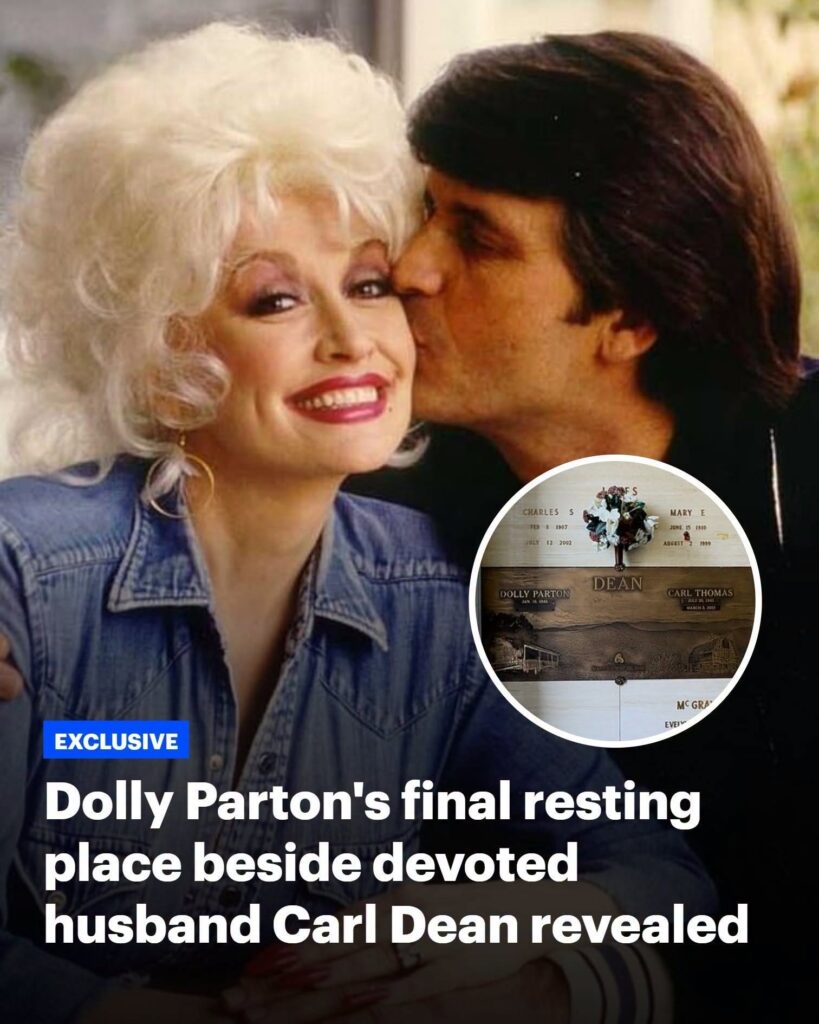
Nestling in a bucolic corner of her beloved Nashville, this is the final resting place of country music icon Dolly Parton, the Daily Mail can reveal.
Woodlawn Memorial Park is a world away from the packed arenas and Hollywood parties where the Tennessee-born star spent more than six decades in the spotlight.
But the serene, oak-lined cemetery is where the legendary singer will be laid to rest beside her devoted husband of nearly 60 years, Carl Dean.
Carl, a blue-collar Nashville businessman who shunned the spotlight, was entombed in the park’s mausoleum after he died in March 2025 at the age of 82.
There was never any doubt his wife would join him there – as her name was carved into his memorial stone well in advance of her death Tuesday, aged 80.
Parton will join a who’s who of country royalty buried on the 205-acre grounds at Woodlawn, three miles from Nashville’s famed Music Row.The queen of country’s representatives revealed she died Tuesday following a ‘brief battle with cancer.’ She was 80 years old
Dolly Parton will be laid to rest beside her husband of nearly 60 years, Carl Dean, in the Woodlawn Memorial Park Funeral Home Mausoleum, the Daily Mail can reveal
Visitors have long made pilgrimages to see the graves of stars including George Jones, Tammy Wynette, Marty Robbins, Little Jimmy Dickens and Porter Wagoner.
It was Wagoner who gave Parton her big break when she appeared on his show in 1967, before the pair went on to perform numerous duets.
Their partnership soured when Parton decided to pursue a solo career – prompting her to pen I Will Always Love You, made famous decades later by Whitney Houston.
Parton’s representatives on Tuesday revealed she died following a ‘brief battle with cancer, though they did not disclose what type of cancer it was.
‘Our beloved Dolly Parton spent her life and career bringing joy, laughter, hope and integrity into everything she touched,’ the statement read.
The couple met at a Nashville laundromat in 1964 when she was just a teenager before marrying in 1966 – the date of which is now displayed on their memorial stone
Parton and Carl Dean on their wedding dayCarl Dean died in March 2025 at the age of 82 from undisclosed causes
Family sources have said Parton will be remembered at a private ceremony for her immediate family, although the location has not been disclosed.
‘Dolly’s fans and friends from around the world are encouraged to pay tribute to Dolly on social media by tagging or by leaving a message at dollyparton.com.
‘In lieu of flowers, the family asks for donations to be made to Dolly Parton’s Imagination Library at http://imaginationlibrary.com,’ the statement added.
Her final resting place will also mark a break with tradition after many of her relatives were buried in Sevierville, close to the Smoky Mountains and the community where the Parton family was raised.
Born into a family of 12 children, Parton arrived in Nashville as a teenager with little more than her talent and an ambition to become a country singer.
It was also where she met Carl outside a laundromat in 1964 when she was 18 and he was 21. They married two years later and remained together for almost 59 years.It is tempting to say that, since Parton died so soon after her beloved husband’s death, she never really recovered from the loss
It is tempting to say that, since Parton died so soon after her beloved husband’s death, she never really recovered from the loss
Parton enjoyed an illustrious music career that spanned six decades
Parton went on to become one of the nation’s most recognizable stars of any musical genre, with a career spanning 60 years, 49 solo albums and countless hits like 9 to 5 and Jolene.
But Dean rarely appeared at public events with his wife and was famously uncomfortable with the attention that came with her fame.
He ran his own asphalt-paving business, preferring a quiet life away from the cameras.
‘Carl and I spent many wonderful years together,’ Parton wrote after Dean died last year from an undisclosed illness.
‘Words can’t do justice to the love we shared for over 60 years. Thank you for your prayers and sympathy.’
Parton later told People magazine she was struggling to adjust to life without him.
‘We were together 60 years. I’ve loved him since I was 18 years old,’ she said.
‘It’s a big adjustment just trying to change patterns and habits.
‘But I’ll always miss him, of course, and always love him. He was a great partner to me.’
Prior to her death Tuesday, Parton had previously raised fan concerns at the end of September, when she announced that unspecified ‘health challenges’ had forced her to postpone her Las Vegas residency, originally scheduled from December 4 to December 13 at the Colosseum Theater at Caesars Palace, until September 2026.
In an interview published just four days before her death, Parton had declared she still had ‘so many things I want to achieve’ and vowed to continue ‘working as long as I can to see everything come to life,’ via People.
She also admitted she had recently been having ‘hard times with my health.’
Parton will also join fellow country music star Porter Wagoner at the resting place
Parton will also join fellow country music star Porter Wagoner at the resting place
It was Wagoner, who died in 2007, who gave Parton her big break when she appeared on his show in 1967. Above, together before his death that year
It was Wagoner, who died in 2007, who gave Parton her big break when she appeared on his show in 1967. Above, together before his death that year
‘We will always love you,’ a sign left by a fan said, while others read ‘in the arms of Jesus’, and ‘we love Dolly’
‘We will always love you,’ a sign left by a fan said, while others read ‘in the arms of Jesus’, and ‘we love Dolly’
She always said the wigs were her “armor,” a way to step onstage as the larger‑than‑life Dolly the world needed, while quietly protecting the woman underneath. Beneath that towering hair was soft, simple blonde – the kind she once wore in a tiny recording booth, chasing a dream with nothing but a sweater, a song, and stubborn hope. That hidden version of her, revealed in rare photos and cherished memories, feels even more precious now that she’s gone.
Fans aren’t just mourning a superstar; they’re grieving the girl from Tennessee who never stopped tending the hair no one saw, loving the husband who teased she looked like a “Q‑Tip,” and giving away more kindness than she ever kept. The wigs may have been costume, but the heart beneath them was never pretend – and that’s the Dolly the world is holding onto now.
Cigarette prices in France have increased noticeably over the past several years, with government policies playing an important role in shaping the cost consumers see in stores. These price changes are part of wider public health efforts designed to reduce smoking rates, encourage healthier habits, and increase awareness about the long-term effects associated with tobacco use.
The price of a cigarette pack is not determined by a single factor. Several elements contribute to the final retail cost, including manufacturing expenses, transportation, packaging, distribution, retailer margins, and government taxes. Understanding how these parts work together helps explain why cigarette prices in France are higher than many consumers might expect.
The process begins when tobacco manufacturers or importers calculate a proposed retail price. Companies consider the costs involved in producing the product, moving it through supply chains, and making it available to retailers. These proposed prices must then go through an official approval process before they can be applied in stores.
French authorities review and approve tobacco prices to maintain consistency across the country. Once a price is accepted, it becomes the official retail price for that product nationwide. This system means consumers generally pay the same amount for the same cigarette brand regardless of where they purchase it, helping create a uniform pricing structure.
A major reason for the high cost of cigarettes in France is the significant role of taxation. Government taxes represent the largest portion of the final price of a cigarette pack. These taxes include tobacco duties and value-added tax, commonly known as VAT. The structure is designed to generate public revenue while also supporting policies intended to discourage excessive tobacco consumption.
Excise taxes on tobacco products are usually calculated using a combination of methods. Part of the tax can be based on the retail price, while another part is linked to the quantity of tobacco contained in the product. Minimum tax levels may also be applied to ensure that tobacco products remain within a consistent pricing framework.
Retailers also receive a regulated commission from cigarette sales. This allows stores and tobacco outlets to cover operational costs associated with selling tobacco products. Meanwhile, manufacturers receive a smaller portion of the final price to cover production, packaging, logistics, and other business expenses.
Over time, repeated tax adjustments and pricing policies have contributed to a steady increase in cigarette costs. These measures are intended to influence consumer behavior by making tobacco products less affordable, while also helping fund public health programs and awareness campaigns.
By early 2026, the average price of a standard 20-cigarette pack in France was around €12.50 to €13, depending on the brand. The exact price can vary slightly between different products, but the overall trend has been a continued increase compared with previous years.
The rising cost of cigarettes reflects a broader approach used by governments in many countries to address tobacco consumption. Higher prices are often combined with education campaigns, prevention programs, and regulations designed to provide more information about the impact of smoking.
For consumers, these changes mean that cigarette purchases represent a larger expense than in the past. For policymakers, the goal is to balance taxation, public health objectives, and economic considerations.
Understanding how cigarette prices are calculated provides a clearer picture of why tobacco products have become more expensive and how government decisions influence the everyday costs faced by smokers.


0 commentaires:
Enregistrer un commentaire